
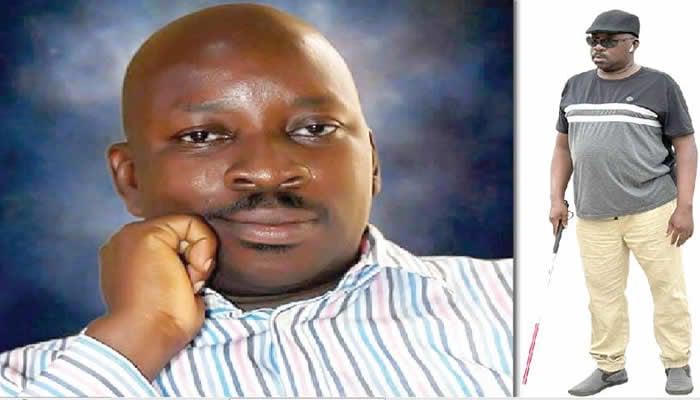
Former journalist KOLAPO ABIODUN interviewed by Temitope Adetunji
Could you share your journey as a journalist and experience in the printing press before losing your sight?
I earned my degree in English Language from Ogun State University, now Olabisi Onabanjo University in 1990 and began my career as a journalist at a health-focused media house.
This role required me to interpret complex medical material and present it in a way that was accessible to the general public.
Our emphasis on feature writing distinguished it from conventional journalism and equipped me for future challenges.
Before losing my sight, I led an active life filled with various leadership roles. I served as the president of my residents’ association and chaired the Alimosho branch of professional printers.
Additionally, I was the vice chairman of my secondary school alumni association and held a principal officer position in my university alumni chapter in Lagos. I also ran a successful printing press that covered the entire value chain of the profession.
However, in an instant, my vibrant life transformed into one of pain, redundancy, and loneliness reminiscent of the biblical proverb about sudden downfall. This experience taught me a crucial lesson – no matter how comfortable life may seem, circumstances can change dramatically at any moment.
During a crisis when the industry was in turmoil and salaries were nonexistent, I ventured into private business. After several years, I returned to communications as a corporate affairs manager and eventually worked as a public relations manager at an oil and gas company. After a few years, I left to establish my own printing company, which was a long-held dream.
As an Ijebu boy, printing runs in my blood. My company, located in Ikotun, became known for book publishing. We started small, but over time, it grew and became fairly successful.
My background in English allowed me to add value to my clients, enhancing their projects with my editing skills. In addition to my business endeavours, I engaged in community service and continued to take on leadership roles.
How would you describe your life before you became visually impaired, both personally and professionally?
I was doing well in my printing business, handling notable clients and printing bestselling books. However, in February 2020, I faced a significant challenge. I had been diagnosed with glaucoma earlier but was managing it well without glasses and visiting the hospital regularly to take my medications.
Despite being diagnosed with glaucoma, I drove very well. In February, after a trip to Ilorin with my wife, I noticed that my left eye had turned red upon waking up the next day. Following a visit to an optician, I was referred to a tertiary hospital in Lagos.
It was there that I experienced the harsh reality of Nigeria’s health system. For three months, I visited the hospital daily but only saw the consultant twice. After a procedure on my left eye, I wasn’t provided with the necessary medications, and unfortunately, I lost vision in that eye.
Reflecting on my experience, I wondered why I hadn’t sought alternative healthcare sooner. Eventually, I went to a private hospital, where the doctor asked if I had suffered an injury to my left eye previously. After some thought, I recalled an incident from years earlier when a traffic officer struck my left eye with a horsewhip while I was driving.
This injury, combined with the delayed treatment, likely contributed to my vision loss.
Later, while managing my glaucoma and attending a private hospital, the COVID-19 lockdown halted access to eye clinics, which worsened my condition. My left eye became infected, and I subsequently lost that eye completely.
The complications continued, and I started losing vision in my right eye.
When the lockdown was lifted, I reached out to my consultant and was advised to undergo surgeries to regain my sight. I had numerous surgeries and even had implants placed in my eyes but perhaps the implants weren’t fitted correctly. Unfortunately, the damage had already been done. It was a deeply depressing moment for me; it was difficult. I had to stop going to the hospital.
Imagine the experience of someone who had been so active suddenly undergoing a complete 360-degree shift like that. I lost my vision and fell into depression at one point because I saw my whole world crashing down in front of me.
What were the biggest challenges you faced after losing your sight?
My business collapsed due to the actions of those I put in charge. I had to sell my machines and other equipment as scrap, items I purchased for millions of naira.
Despite these challenges, some people stayed with me. I will never forget the friends who consistently called and visited, but there was only so much they could do.
After the COVID-19 lockdown, people returned to their regular routines; my wife went back to her job, and my children resumed school. It was then that it dawned on me that I was alone and had to navigate this experience practically all by myself.
My wife tried her best for me. She is a truly fantastic woman. However, as the stress of taking me to the hospital while balancing her work became overwhelming, an Igbo neighbour offered to take me to the hospital. Despite not being Yoruba, she was incredibly kind.
I discovered that the Igbo community stepped up for me even more than the Yoruba community. Aside from a few friends, I felt somewhat abandoned. I faced a choice between living and ending my life, but I chose to live. Eventually, I turned to farming as a way to cope.